Horse Racing Betting: How Distance, Surface and Draw Affect Results
Horse racing form is never shaped by one number alone. A horse may arrive with strong recent results yet face a very different test because the race is shorter, the surface has changed or the starting stall creates a difficult early position. For bettors, these details are useful because they help explain why the same horse can perform very differently from one race to the next. British Flat racing in 2026 continues to offer a wide range of contests on turf and all-weather tracks, over distances stretching from sharp five-furlong sprints to races of two miles and beyond. Distance determines how much speed and stamina are required, the racing surface affects how comfortably a horse can produce its normal action, and the draw can influence the amount of ground covered or the position available during the opening stages. None of these factors can predict a winner on its own, but considering them together gives a much clearer picture of the conditions each runner must handle.
Why Race Distance Changes the Shape of a Bet
Distance is one of the first details worth checking because it changes both the physical demands of a race and the tactics available to jockeys. Five and six furlong contests are normally built around acceleration and the ability to hold position at a strong early pace. Horses have relatively little time to recover from a slow start, traffic problems or an inefficient move across the track. A runner that loses several lengths leaving the stalls in a five-furlong sprint may have only about a minute of racing in which to make up the deficit. In longer races, there is more time to settle into position, but stamina becomes increasingly important. A horse travelling strongly at a mile may not necessarily maintain the same efficiency over ten or twelve furlongs, particularly when the early pace is demanding.
The British Horseracing Authority identifies five furlongs, six furlongs, seven furlongs, one mile, one mile two furlongs, one mile four furlongs, one mile six furlongs and two miles among the key distances used for Flat racing. These distances should not be treated as interchangeable when analysing form. A horse that repeatedly runs well over seven furlongs may lack the finishing speed required for six furlongs, while a proven miler stepping up to ten furlongs must show that its performance does not weaken when stamina is tested for longer. Recent results over or close to the scheduled trip generally provide more useful evidence than an isolated strong performance at a substantially different distance.
Distance also changes the importance of pace. In a sprint, several horses may compete for an early position almost immediately after leaving the stalls. That can produce a fast opening section and place extra pressure on runners that prefer to race prominently. Longer races may develop more slowly, allowing jockeys to conserve energy before increasing the tempo later. The betting question is therefore not simply whether a horse has previously won at the distance. It is whether the likely race pattern suits the way that particular horse normally runs. A front-runner moving into a race containing several other habitual leaders faces a different test from the same horse competing against rivals that usually settle behind the pace.
Reading a Horse’s Record at the Relevant Trip
Past performance at the same distance is a useful starting point, but the figures need context. A record showing two wins from four starts over one mile appears positive, yet those races may have taken place at very different courses and under different conditions. One could have been a small-field race run slowly before developing into a short sprint to the line, while another could have involved a large field and sustained pressure from halfway. Looking at how the horse achieved the result is often more informative than simply counting wins. Finishing strongly after being held up suggests something different from controlling a race from the front without facing serious pressure.
Changes in distance should also be judged against the horse’s recent runs. When a runner is moved up in trip after repeatedly weakening late over a shorter distance, the extra ground does not automatically solve the problem. Conversely, a horse that finishes strongly over seven furlongs may be worth closer attention when moving to a mile, particularly when previous form or breeding indicates that the longer race should be manageable. Dropping in distance creates a different question. A horse accustomed to ten furlongs may have plenty of stamina but struggle to match the early speed of specialists when returning to a mile.
Course layout should be considered alongside distance because two races over the same trip can develop differently. One mile on a broad, galloping track may provide a long run before the main turn and enough room for horses to find a comfortable rhythm. The same nominal distance on a tighter course can place greater emphasis on early position and efficient cornering. Bettors therefore gain more from reading distance form as part of a wider pattern rather than treating a previous course-and-distance win as automatic proof of suitability. Current fitness, class, pace, surface and the strength of the opposition still matter.
How Turf and All-Weather Surfaces Change Performance
Surface conditions can change the way a race is run even when the distance and class remain identical. Turf is particularly variable because rain, dry weather, irrigation and previous racing influence the condition of the ground. Descriptions such as firm, good, good to soft, soft and heavy give bettors a general indication, but individual courses can react differently to similar weather. Some horses produce their strongest form on quicker turf, where maintaining speed is important, while others are more effective when the ground contains additional moisture and the race becomes a greater test of stamina. Previous results under comparable conditions therefore deserve attention, especially when a horse has shown a consistent preference.
All-weather racing offers greater consistency but should not be treated as a single type of racing surface. British courses use synthetic materials including Polytrack and Tapeta, and horses do not always transfer identical form between them. Chelmsford City, for example, races on Polytrack, while Newcastle and Southwell use Tapeta. The BHA’s 2025 industry figures recorded 2,793 Flat all-weather races compared with 3,748 Flat turf races, so synthetic-track form represents a substantial part of the British racing programme rather than a minor winter speciality. For betting purposes, a horse’s actual record on the relevant surface is normally more useful than a broad assumption that good all-weather form applies everywhere.
The condition of a synthetic track can also change through maintenance. Chelmsford City confirmed in August 2026 that its Polytrack had been rewaxed during the summer after the surface had become dustier and lost some of its binding qualities. The work was intended to improve consistency and reduce kickback. Turf schedules can change as well. In August 2026 the BHA approved the transfer of several Lingfield Park fixtures from turf to the all-weather course because prolonged dry conditions affected the ability to prepare the turf satisfactorily. Examples such as these show why bettors should check the confirmed race surface and current course information rather than rely entirely on older form notes.
What to Check Before Backing a Horse on a Different Surface
The simplest question is whether the horse has already competed successfully under comparable conditions. A runner with repeated strong performances on Tapeta provides more direct evidence than one making its synthetic-track debut after racing exclusively on turf. The same principle applies in reverse. An excellent all-weather record does not guarantee equivalent turf form. When direct evidence is limited, performances on similar surfaces, trainer placement and previous attempts under related conditions can help, but they remain supporting information rather than proof that the horse will reproduce its best rating.
Running style can provide additional context. Horses racing behind several rivals on synthetic tracks may encounter kickback, while prominent runners can sometimes avoid much of it. That does not mean front-runners should automatically be preferred because a strong early pace can leave them vulnerable late in the race. On turf, the preferred part of the course may also shift as a meeting develops. Ground near one rail can become more worn than another section, while recent rain may affect areas differently. Watching earlier races on the same card can therefore provide information that historical statistics cannot fully capture.
Price remains important when surface preferences appear obvious. If a horse has an excellent record on a particular track, bookmakers and other bettors are usually aware of it, meaning much of that advantage may already be reflected in the odds. The useful question is not simply whether the horse likes the surface, but whether the market price fairly represents its chance after class, recent form, pace and opposition are considered. A surface specialist facing a stronger field may still be poorly priced, while a horse with limited course experience can be underestimated if its previous performances suggest the conditions should suit.

How the Draw Alters Position, Pace and Ground Covered
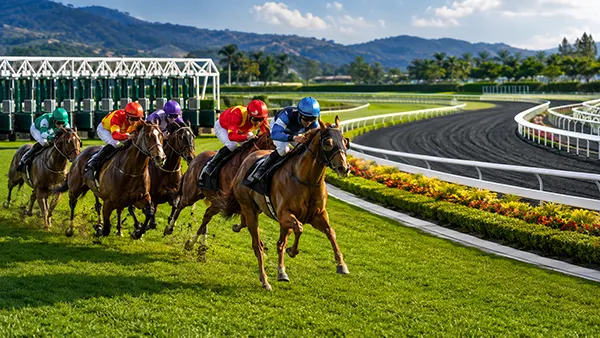
The draw assigns each Flat runner a starting stall, but its importance varies considerably from race to race. There is no universal rule that a low or high number is automatically preferable. On a turning course, the relationship between the stalls and the first bend can matter because a runner drawn wide may need to travel farther if it remains outside other horses. Moving towards the inside rail can reduce that extra ground, but doing so may require early speed and can use valuable energy. On straight courses, the situation is different: horses can remain on separate parts of the track, and any advantage may depend on ground condition, pace concentration and which side receives the strongest competition.
Field size makes these effects more noticeable. In a six-runner race, a horse drawn widest may still find a suitable position without much difficulty. In a field of twenty or more, the same type of draw can create far more tactical problems. An inside stall can save ground around a bend, but a slow-starting horse may become boxed behind rivals. A wide stall can require extra distance, yet it may give a horse clear running room and reduce the risk of being trapped in traffic. For this reason, the draw should always be read together with the horse’s usual racing position and the expected behaviour of nearby runners.
Royal Ascot in June 2026 provided a useful reminder that draw-related advantages can also develop during a meeting rather than remain fixed in advance. Several straight-course races produced discussion about the performance of horses racing towards different sides of the track, but analysis also showed that pace distribution, traffic and the amount of ground already used during the meeting complicated simple claims that one set of stall numbers held a permanent advantage. For bettors, this is important. Historical draw tables are useful background information, but the evidence from the current meeting may be more relevant when rainfall, rail movements or repeated racing change the effective condition of different parts of the course.
A Practical Pre-Race Method for Combining All Three Factors
A practical assessment can begin with four connected questions. First, is the horse proven or reasonably suited to the race distance? Second, does its form suggest that the declared surface and current conditions are suitable? Third, does the stall position make it easier or harder to obtain the horse’s usual racing position? Fourth, what type of pace is likely to develop from the runners around it? Looking at these points together prevents a single attractive statistic from dominating the decision. A strong draw cannot compensate automatically for unsuitable ground, just as proven stamina does not remove the problems created by poor positioning in a slowly run race.
Consider a hypothetical six-furlong race where a proven Polytrack sprinter is drawn close to the inside on a course with an early bend. If the horse normally breaks quickly and races near the lead, the draw may allow the jockey to save ground without spending too much energy obtaining position. A rival drawn wide may possess a similar rating but need either to race outside other horses or accelerate early to move across. That gives the first runner a potentially cleaner setup, but it still does not make the result certain. If several other fast starters are drawn nearby, the early competition could become intense and turn the apparent positional advantage into a demanding pace battle.
The final decision should always include the odds and the amount being risked. Distance, surface and draw are tools for estimating probability, not guarantees. Horses can miss the start, encounter traffic, race below their recent form or simply meet a better-performing rival on the day. A sensible staking approach therefore matters as much as race analysis: decide the stake before the race, keep it within an affordable betting budget and avoid increasing it simply to recover a previous loss. Used this way, distance, surface and stall position help explain the race more accurately without creating false certainty about an inherently unpredictable result.